Odum School of Ecology, University of Georgia · Senior Editor, Ecology Letters
Ecological Society of America 2026
Salt Lake City, Utah
July 3, 2026
The journal at a glance
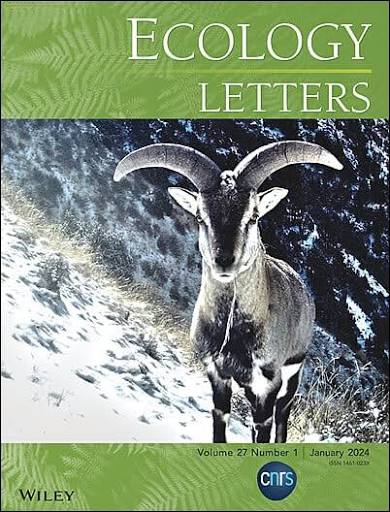
Founded 1998; published by Wiley in association with the CNRS (French National Centre for Scientific Research)
International, high-selectivity outlet for concise, conceptually novel ecology
Rolling online publication · ISSN 1461-023X (print) / 1461-0248 (online)
By the numbers
Impact factor 7.9 (2024 Journal Citation Reports) — consistently among the top general-ecology journals
Highly selective: the majority of submissions are declined, many without review
Short-format by design — a Letter is capped at 5000 words
A commercial journal with a national-agency backbone
History and the CNRS
Launched in 1998 and built quickly into a flagship outlet for general and theoretical ecology
Published by Wiley in association with the CNRS — France’s national research organization, founded in 1939 and one of the largest in the world
The partnership gives the journal a scientific, non-commercial anchor: editorial direction sits with the scientific board, not the publisher
The senior editorial team
Pete Thrall Editor-in-Chief
John Drake Methods & Perspectives
Jonathan Chase Syntheses
Helene Muller-Landau Senior Editor
Barbara Han Senior Editor
Akira Mori Senior Editor
The senior editors set policy and make the final call; each stewards one or more article types. Behind them, the editorial office — Nathalie Espuno and Stephane Hello — keeps papers moving. They are real people in real offices, not bots, and responsiveness to their emails is the single most important courtesy an editor can offer.
A distributed editorial board
Three functionally distinct roles:
Role
What they do
Editor-in-Chief & Senior Editors
Set policy, make final decisions and appeals, give strategic direction
Associate Editors
Handle peer review for individual papers: assess, choose reviewers, interpret reviews, recommend a decision
Data Editors
Check code and data availability, open-science compliance, reproducibility
Ecology Letters runs a broad, distributed board rather than a few high-volume handling editors — more expertise, wider representation, fewer bottlenecks.
The associate editors
Frederick R. Adler Michelle Afkhami Marina Alberti Greg Albery William Anderegg Sally Archibald Louise Amy Ashton Edith Bai Petr Baldrian Gyuri Barabas Richard D. Bardgett Andrew Barnes Ignasi Bartomeus Frida Ben-Ami Cleo Bertelsmeier Carl Boettiger Jedediah Brodie Ulrich Brose James (Jeb) E. Byers Vincent Calcagno Cayelan Carey Jane Catford Ryan Chisholm Liza Comita Julien Cote Franck Courchamp Tad Dallas Jonathan Davies Nico De Bruyn Frédérik De Laender Luc De Meester Franciska De Vries Laura Dee Manuel Delgado-Baquerizo Hideyuki Doi Ian Donohue Anu Eskelinen Laura L. Figueroa Claire Fortunel Jean-Michel Gaillard José María Gómez Martin Gossner Gregory Grether Paulo Roberto Guimarães Vishwesha Guttal Nick Haddad Fangliang He Mikko Heino Fujio Hyodo Punidan Jeyasingh Anna Jolles Ferenc Jordán Po-Ju Ke Johannes M H Knops Sarah Knowles Meghna Krishnadas Kevin Lafferty Jonathan Lenoir Lee Hsiang Liow Lingli Liu Dustin Marshall Jason Matthiopoulos Sean Michaletz Arne Mooers Juan Manuel Morales Erin Mordecai David Mouillot Stephen Munch Tamara Münkemüller Shuli Niu Vojtech Novotny Rick Ostfeld Jelena Pantel Josep Peñuelas Malin L. Pinsky Mathias Pires Timothée Poisot Jennifer Powers Heather Reynolds Pejman Rohani Kristen Ruegg Rob Salguero-Gómez Christoph Scherber Thad Scott Marc-André Selosse Emily Shepard Lauren Shoemaker Andrew Sih Chuliang Song Gabriele Sorci Orr Spiegel Adrian Stier David Storch Nathan Swenson Marlee Tucker Ted Turlings Wim H. van der Putten Diego Vázquez Montserrat Vilà Cyrille Violle Shaopeng Wang David Westneat John J. Wiens John Williams Tim Wootton
Article types
Type
Purpose
Limit
Letter
Main article type — concise, novel primary research
5000 words · 6 display items
Review & Synthesis
Synthetic advances that reshape a question
7500 words · 10 display items
Perspective
Forward-looking conceptual argument
7500 words · 10 display items
Methods
New methodological or analytical tools
5000 words · 6 display items
Viewpoint
Short opinion or commentary
2000 words · 2 display items
Technical Note
Brief technical point
800 words · 2 display items
Match the recommendation to the type: do not decline a Methods paper for being methodological, or a Viewpoint for being short.
How it all moves: REX
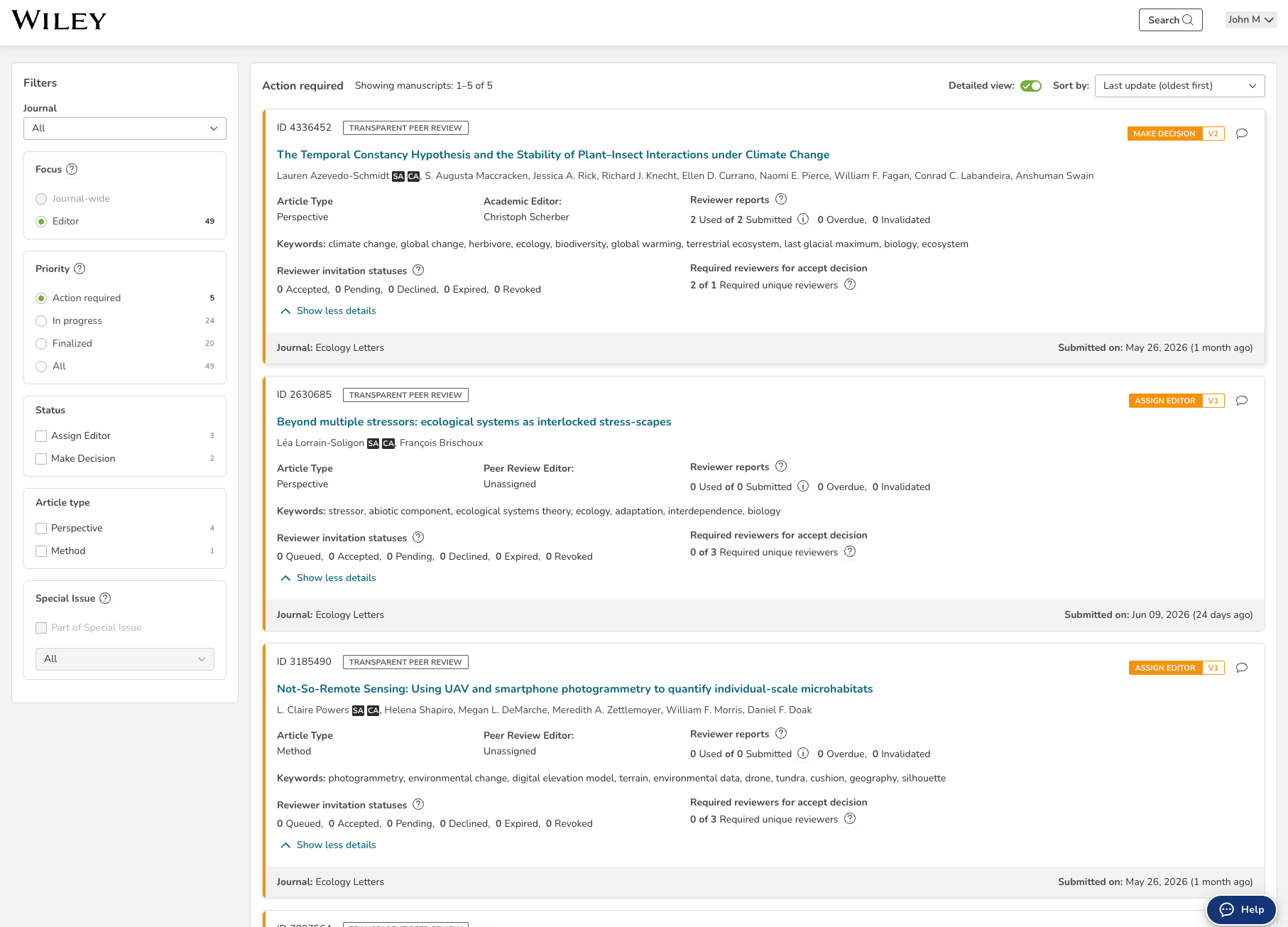
REX is the submission and editorial system where the whole workflow lives — assignments, reviewer invitations, recommendations, and the office’s messages to you.