Globalization, Global Change, and Emerging Infectious Diseases
John M. Drake
Odum School of Ecology & Center for the Ecology of Infectious Diseases
University of Georgia
University of Georgia School of Law
Athens, Georgia
September 21, 2026
The Matsamo border post at Jeppes Reef, Eswatini. Image: Wikimedia Commons
A world poised on edge
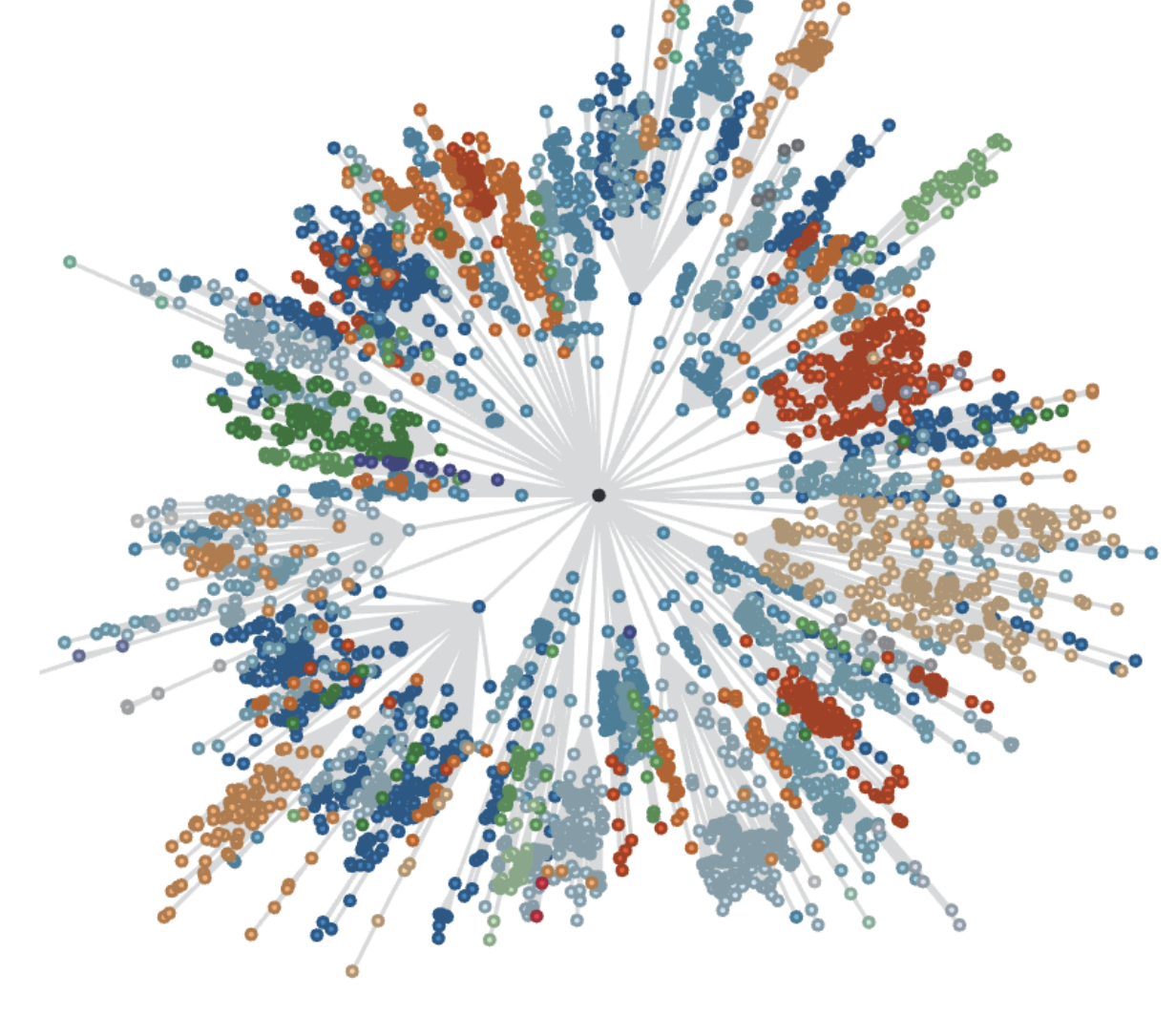
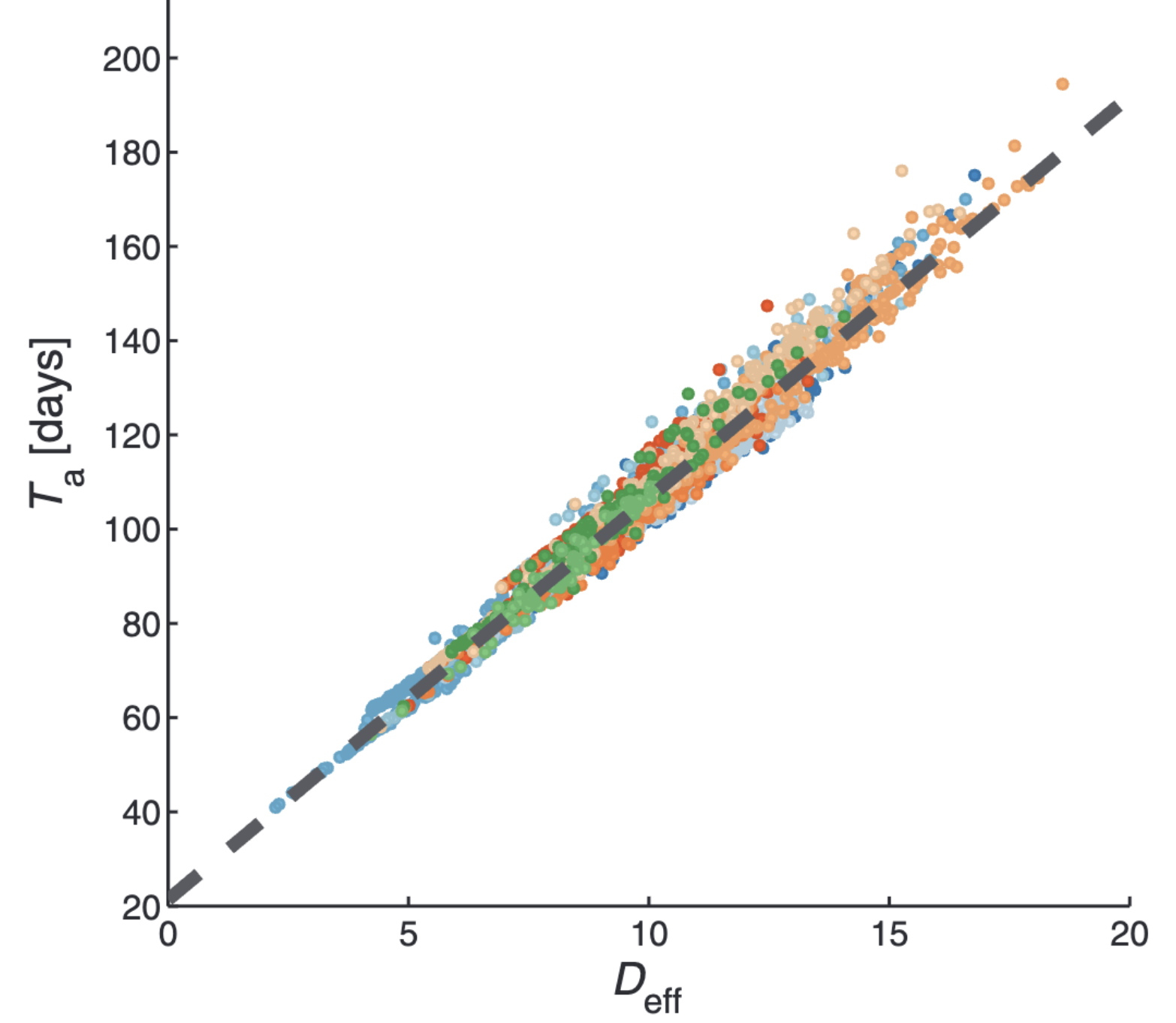
Left: the shortest-path network from Hong Kong to 4,069 world airports. Right: epidemic arrival time is almost perfectly linear in effective distance on that network. Source: Brockmann & Helbing (2013) Science 342: 1337–1342.
What is a pandemic?
Etymological — pan + demos: a disease “of all the people”
Institutional — the PHEIC: “an extraordinary event which constitutes a public health risk to other states through the international spread of disease”
A century of pandemics
Emergency hospital during the influenza pandemic, Camp Funston, Kansas
Image: Wikimedia Commons
Influenza dominated the pandemic century
Event
Origin and route
Influenza A H1N1, 1918–20
Animal-related; spread with WWI troop movements
Influenza A H2N2, 1957–58
China; wild birds → poultry/pigs → humans
Cholera (El Tor), 1961–
Indonesia; food and water; ballast-water spread
Influenza A H3N2, 1968–70
Hong Kong; birds → livestock → humans
Influenza A H1N1, 1977–78
Probable laboratory or vaccine release
HIV/AIDS, 1981–
Central Africa; primate spillovers → global travel
SARS, 2002–03
Guangdong; wildlife farming and live-animal markets
Influenza A H1N1pdm09, 2009–10
Mexico; reassortment in industrial pig farms
Zika, 2007–17
Africa/Asia; urbanization and Aedes mosquitoes
COVID-19, 2019–
Wuhan; wildlife trade or possible lab release
Mpox, 2022–23
West/Central Africa; spillover from wild rodents
Nine of eleven trace to food, agriculture, or water
Event
Origin and route
Influenza A H1N1, 1918–20
Animal-related; spread with WWI troop movements
Influenza A H2N2, 1957–58
China; wild birds → poultry/pigs → humans
Cholera (El Tor), 1961–
Indonesia; food and water; ballast-water spread
Influenza A H3N2, 1968–70
Hong Kong; birds → livestock → humans
Influenza A H1N1, 1977–78
Probable laboratory or vaccine release
HIV/AIDS, 1981–
Central Africa; primate spillovers → global travel
SARS, 2002–03
Guangdong; wildlife farming and live-animal markets
Influenza A H1N1pdm09, 2009–10
Mexico; reassortment in industrial pig farms
Zika, 2007–17
Africa/Asia; urbanization and Aedes mosquitoes
COVID-19, 2019–
Wuhan; wildlife trade or possible lab release
Mpox, 2022–23
West/Central Africa; spillover from wild rodents
Pandemics spread along the corridors of the global economy
Event
Origin and route
Influenza A H1N1, 1918–20
Spread with WWI troop and transport routes
Influenza A H2N2, 1957–58
Encircled the globe with early commercial aviation
Cholera (El Tor), 1961–
Reached Latin America 1991 via ballast water → IMO Convention (2004)
Influenza A H3N2, 1968–70
Spread in step with the jet age
Influenza A H1N1, 1977–78
Probable laboratory or vaccine release
HIV/AIDS, 1981–
Amplified by labor mobility and international travel
SARS, 2002–03
One hotel floor → three continents in days
Influenza A H1N1pdm09, 2009–10
Global pig trade, then global air travel
Zika, 2007–17
Travel + invasive vectors across the Pacific and Americas
COVID-19, 2019–
The full global aviation network
Mpox, 2022–23
International travel networks; 2003 via pet trade
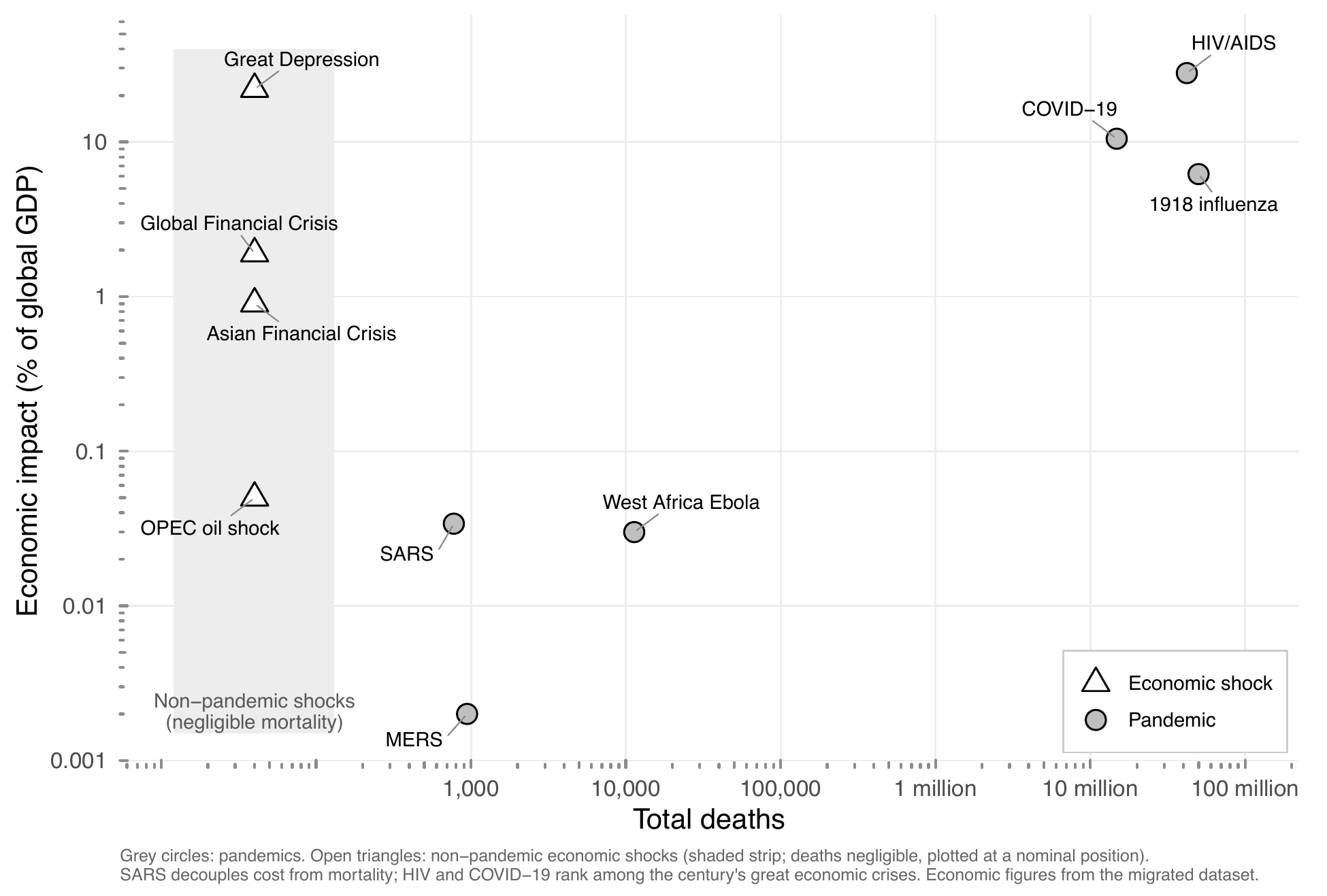
Pandemics rival the great economic shocks of the modern era
Economic impact as a share of world output against total deaths for the century’s pandemics, with the era’s major non-pandemic economic shocks (open triangles) for comparison.
From events to system
Emergence is caused by human action
“Most emerging infections appear to be caused by pathogens already present in the environment, brought out of obscurity or given a selective advantage by changing conditions and afforded an opportunity to infect new host populations… Surprisingly often, disease emergence is caused by human actions, however inadvertently.”
Morse, S.S. (1995) “Factors in the emergence of infectious diseases,” Emerging Infectious Diseases 1: 7–15.
Emergence is a measurable global process
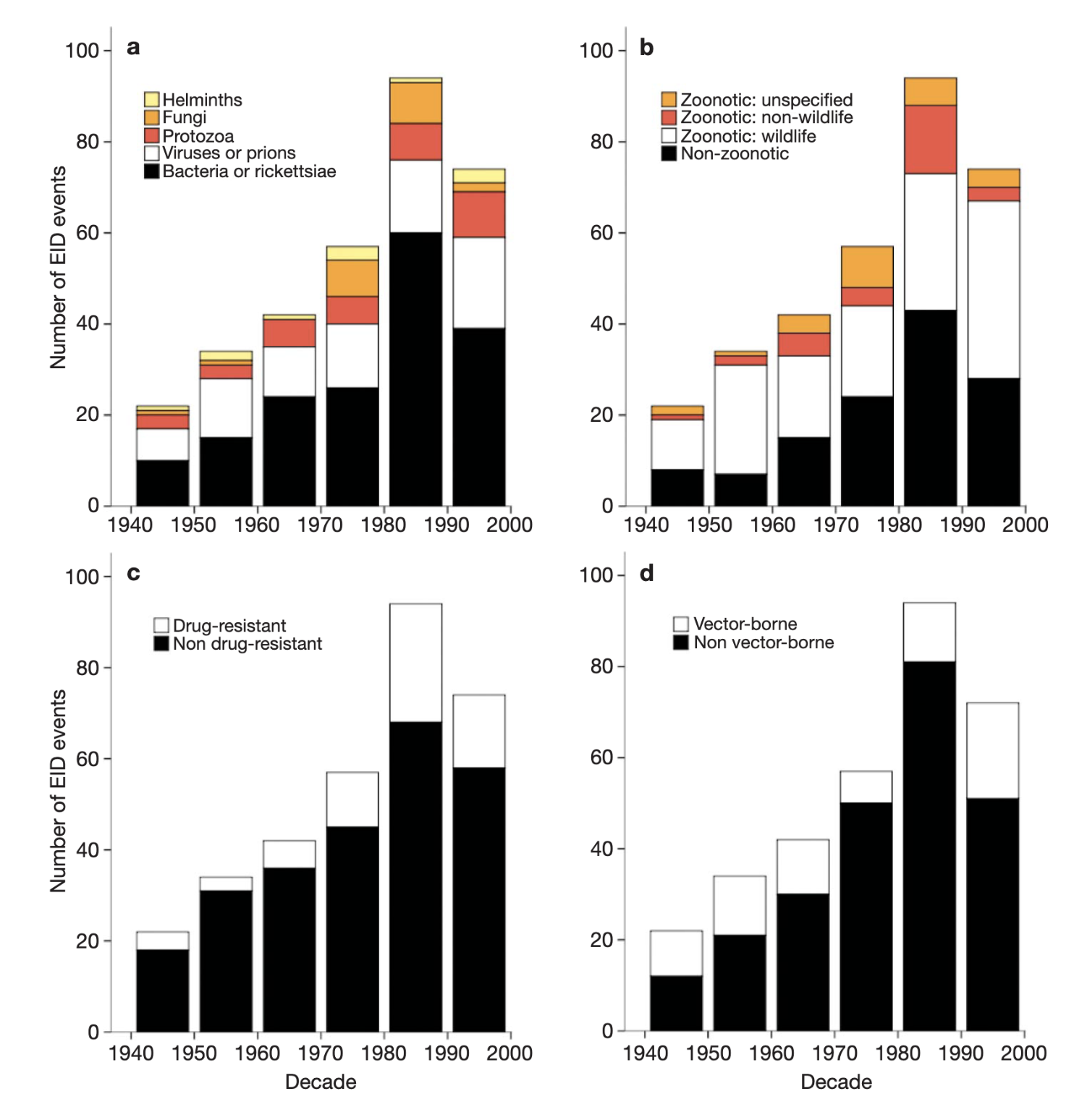
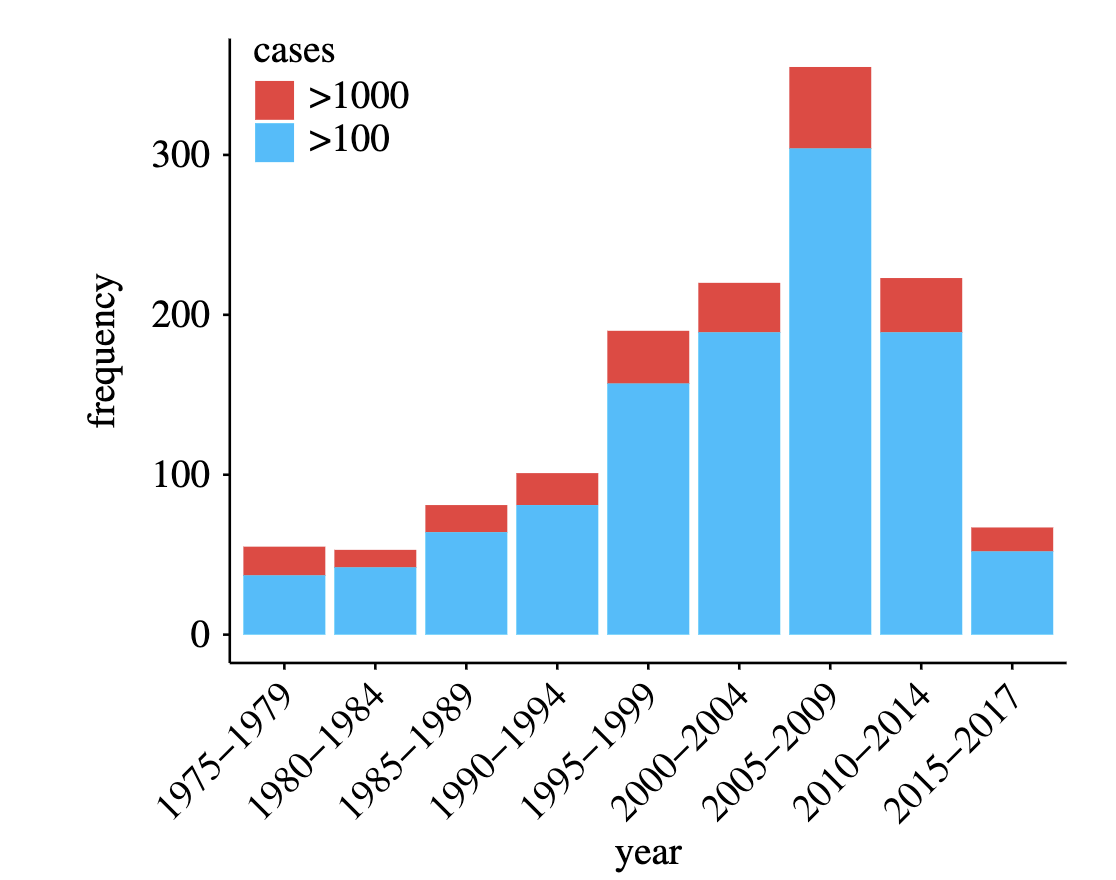
Jones et al. compiled 335 emerging-disease events, 1940–2004: the majority zoonotic, clustered where demographic growth, land-use change, and economic integration accumulate.
Jones, K.E. et al. (2008) “Global trends in emerging infectious diseases,” Nature 451: 990–993.
The list of “drivers” keeps growing — and that is the point
1992 IOM report: 6 factors — microbial adaptation; demographics and behavior; economic development and land use; travel and commerce; technology and industry; breakdown of public health
2003 IOM report: 13 factors — adding climate, ecosystems, poverty and inequality, war and famine, political will, intent to harm…
Stephens et al. 2021: 48 factors in 9 categories
No single driver predicts outbreak size
Across the 100 largest zoonotic outbreaks since 1974, large events involved more drivers than background outbreaks — vector abundance, population density, unusual weather, water contamination — in outbreak-specific combinations.
Stephens, P.R. et al. (2021) Phil. Trans. R. Soc. B 376: 20200535.
Globalization and growth
Globalization is the intensification of worldwide social relations
“Globalization can… be defined as the intensification of worldwide social relations which link distant localities in such a way that local happenings are shaped by events occurring many miles away and vice versa.”
Anthony Giddens (1990) The Consequences of Modernity
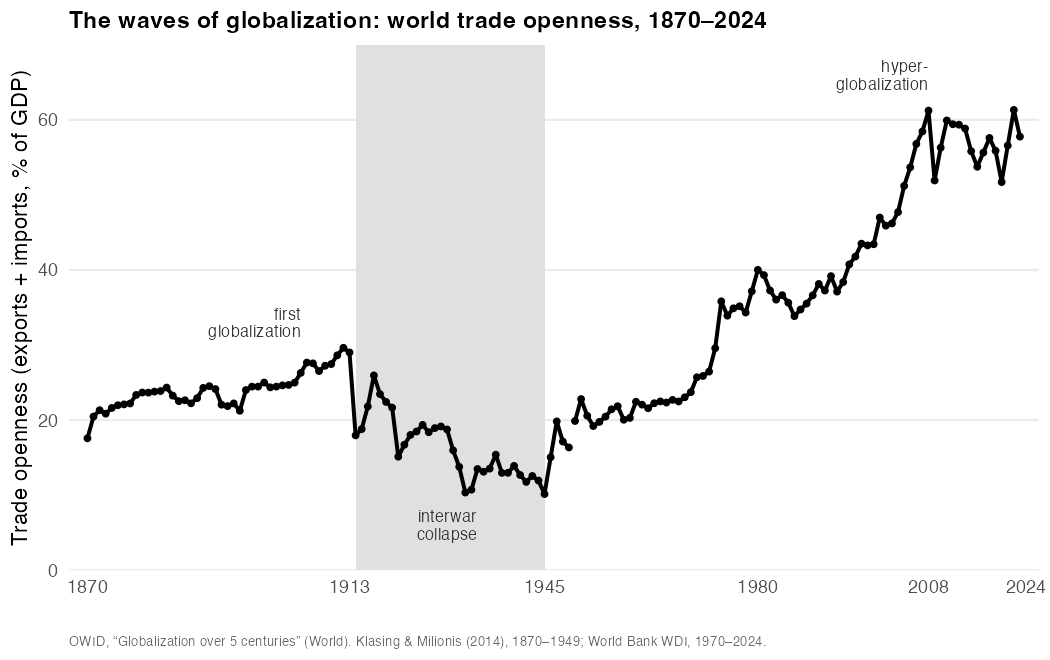
Globalization comes in waves — and has reversed before
World trade openness, 1870–2024. The interwar collapse — trade falling from a fifth of world output to a tenth — is the empirical refutation of any claim that globalization is inevitable.
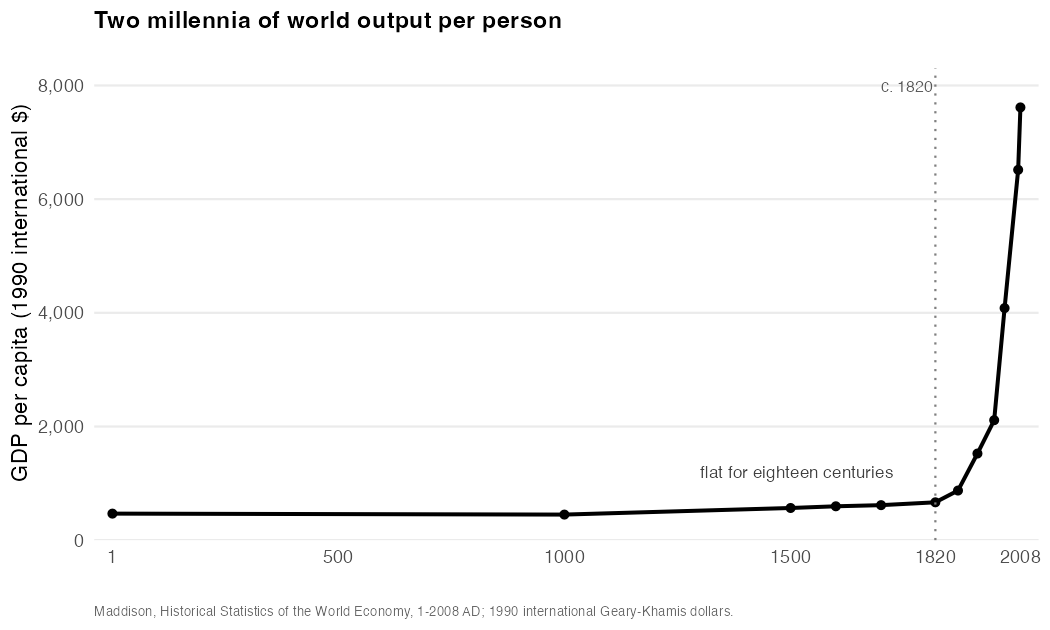
For most of history, there was no growth at all
Global GDP per capita over two millennia: essentially flat for all of recorded history, then a near-vertical ascent beginning around 1800.
Daniel Susskind (2024) Growth: A History and a Reckoning
What broke the stagnation: ideas that don’t run out
Solow (1956) — growth cannot be explained by labor and capital alone; most of it is a residual: technology
Romer (1990) — the residual explained: ideas are nonrival and cumulative — usable by everyone at once, combinable forever
Mokyr — the recipes needed a culture willing to cook: the spread of a scientific mentality
Trade was the unleashing — comparative advantage, with caveats
Ricardo (1817) — England and Portugal, cloth and wine: specialization and exchange leave both parties richer, even when one is better at everything
The evidence — openness helps growth, but by less, and under more conditions, than the boosters claimed
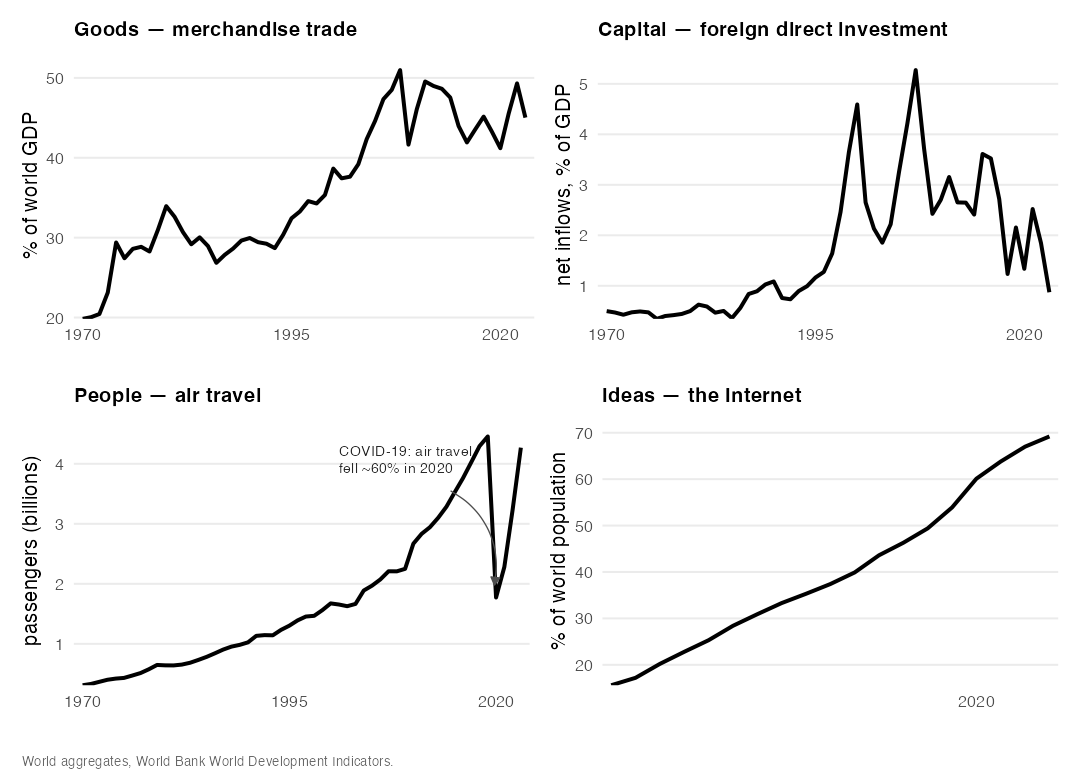
The four flows, measured
Goods, capital, people, and ideas have all intensified their movement across borders — the measurable substance behind the abstraction of “interconnection.” The one sharp reversal: air travel collapsed by ~60% in 2020, then recovered within three years.
The reckoning: growth’s two unpaid debts
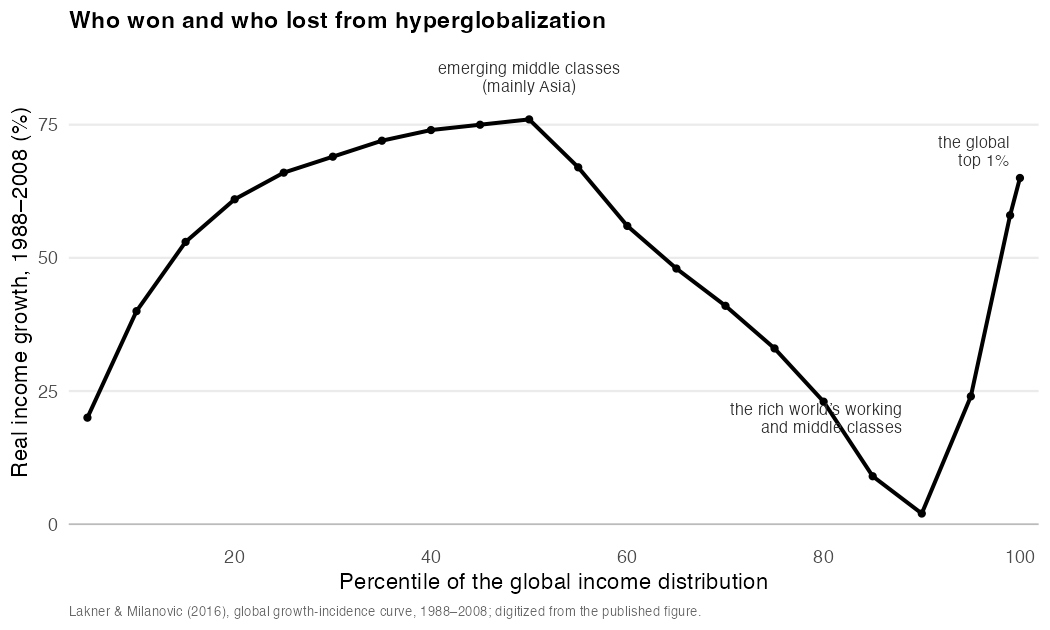
The “elephant curve”: real income growth 1988–2008 by percentile of the global income distribution. Asia’s emerging middle classes and the global top 1% gained most; the rich world’s working classes fell behind in relative terms.
Milanovic (2018); Susskind (2024)
Growth and globalization are a self-reinforcing pair
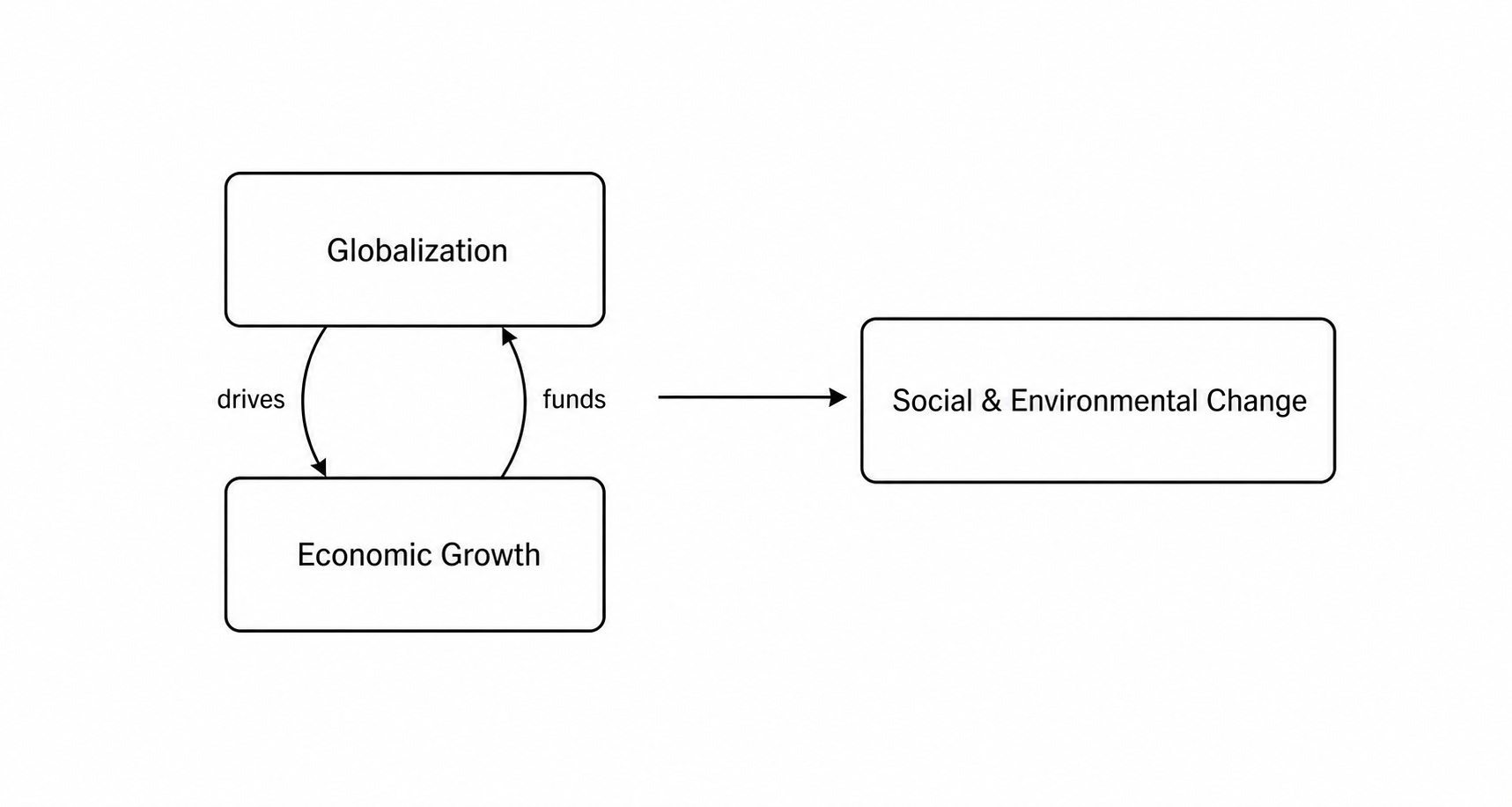
The basic model: globalization and growth drive one another, and their joint output is a wave of social and environmental change.
The globalization grid
Four means, three domains
The means — what moves: goods & services, capital, people, ideas
The domains — what it moves through: economic, political, cultural
Each flow is also a vector — carrying disease along the same channels it opens for everything else
The globalization grid: twelve moments
Economic
Political
Cultural
Goods & services
Commerce
Regulation
Consumption
Capital
Investment
Fiscal power
Philanthropy & impact capital
People
Labor
Migration
Travel & tourism
Ideas
Innovation
Intellectual property
Knowledge sharing
Each cell is a moment of globalization — a place where a flow meets a domain, with consequences for the emergence and control of disease
The chapter I shared is one cell of this grid
Extractive industry = capital × economic: investment opens the frontier — deforestation, mining, roads — and restructures the human–wildlife interface
But spillover is not yet a pandemic — Dobson et al. (2020) price forest conservation at $20–30B/yr; necessary, not sufficient
The pandemics we reviewed ran through other cells — agriculture, mobility, markets, governance
Does the evidence hold? Strong in bulk, knotted in detail
Amazon malaria — 10% more deforestation → ~3% more malaria (MacDonald & Mordecai 2019)
But: outbreak maps partly reflect where health systems can see — reporting falls ~1/3 per hour of travel from care (Gibb et al. 2024)
And: across ~3,000 observations, deforestation per se is a weak, context-dependent driver (Mahon et al. 2024)
What survives: the structural claim, traced case by case
The revised model: disease runs through the twelve moments — and feeds back
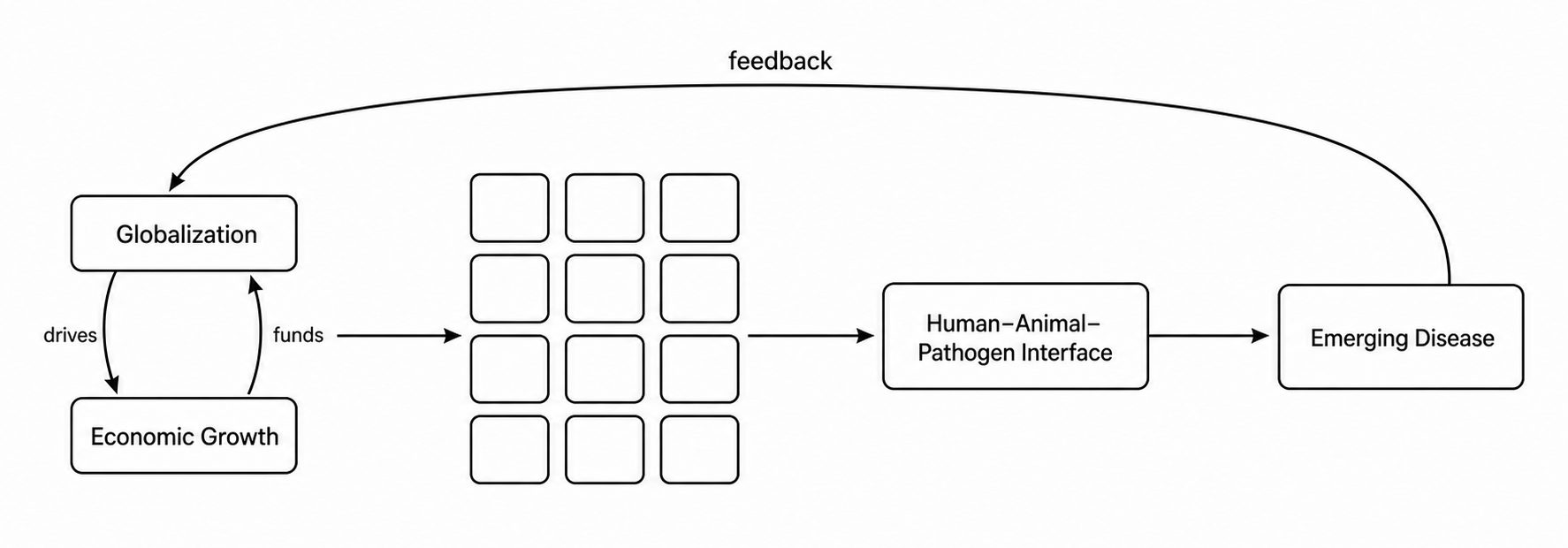
Globalization and growth drive emergence through the twelve moments of the grid — and a pandemic feeds back on the growth and connection that produced it, as 2020 made unforgettable.
Three near-pandemics
Nipah: economic flows restructure ecology
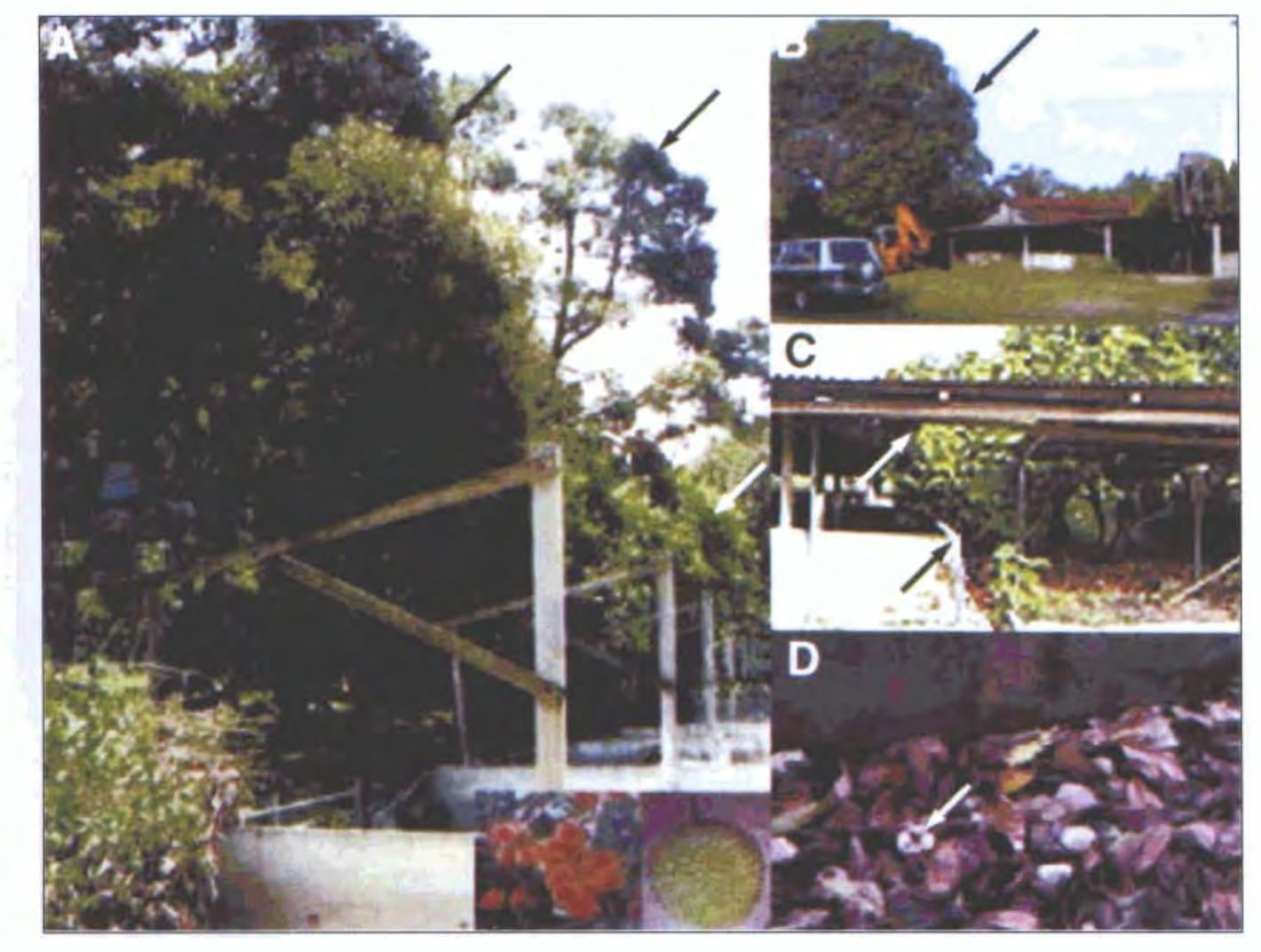
Co-location of pig sty and mango trees, Ampang village, Malaysia — the spillover interface built by agricultural investment.
Image: Chua et al. (2002) Malaysian J. Pathology 24: 15–21.
Chikungunya: globalization as biological transport
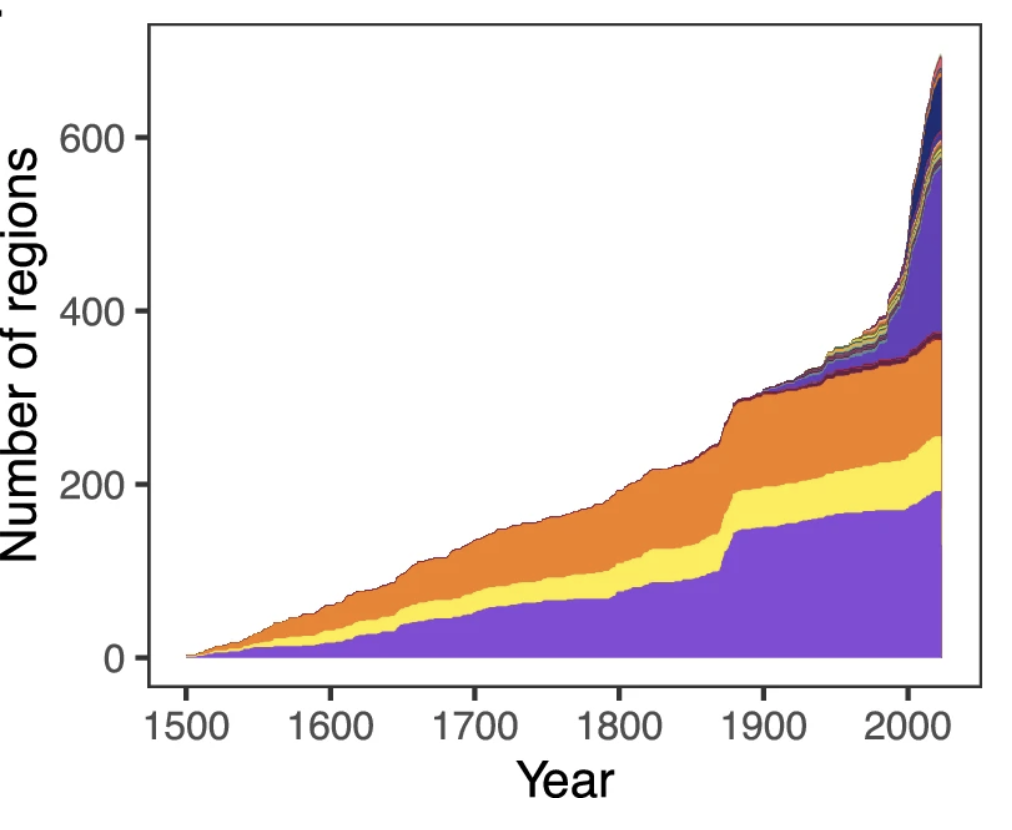
Global introductions of Aedes vectors, 1500–2025: Ae. albopictus — moved by trade in used tires and ornamental plants — is now established on every inhabited continent. Sources: Swan et al. (2022) Parasites & Vectors 15: 303; Pabst et al. (2025) Nature Communications 16: 9127.
SARS 2003: one hotel floor, three continents
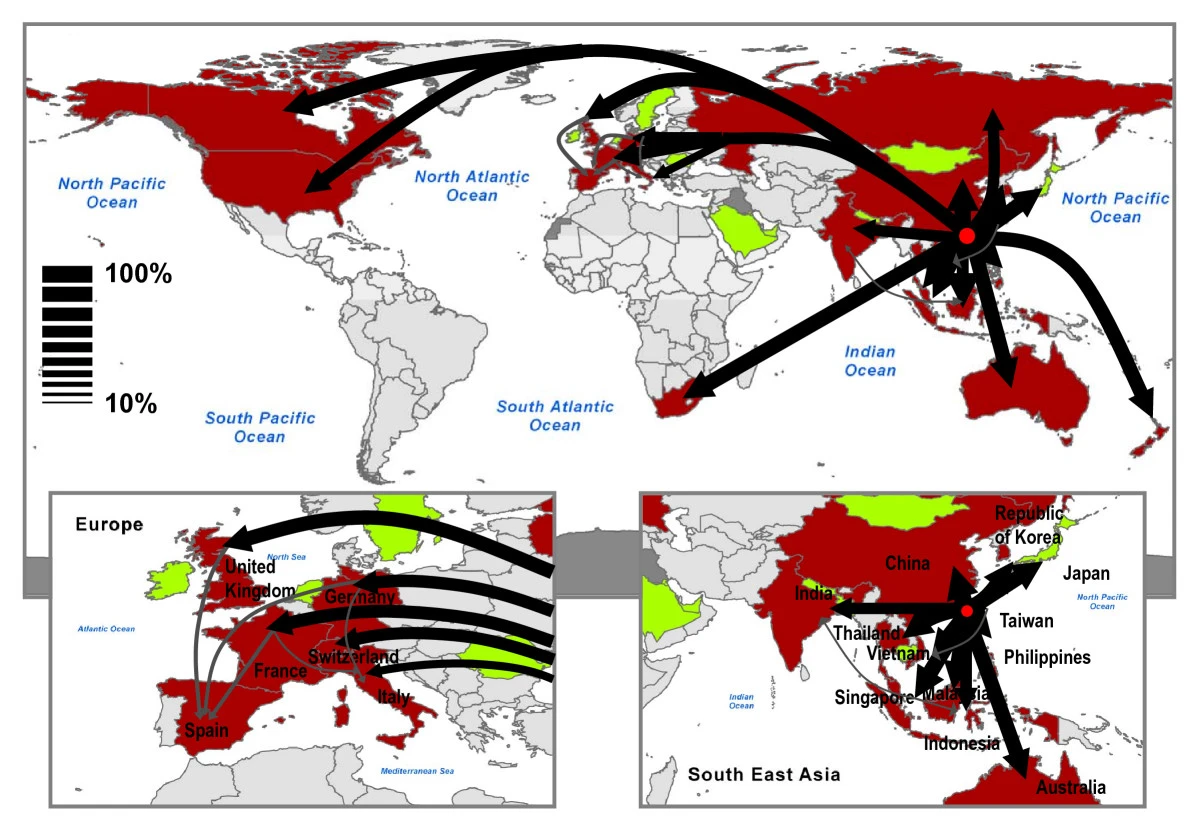
The diffusion of SARS from Hong Kong in 2003 followed the airline network, not geography. Source: Colizza et al. (2007) BMC Medicine 5: 34.
Three cases, three configurations of the same grid
Economic
Political
Cultural
Goods & services
Nipah · Chik
SARS
Nipah
Capital
Nipah · Chik
People
Nipah
SARS
Chik · SARS
Ideas
SARS
Different cells activate in different combinations — emergence is configurational
Three regularities: coupling, acceleration, asymmetry
Coupling — once-separate systems are now tightly linked: bat ecology with industrial livestock; mosquito ecology with shipping; wildlife trade with aviation
Acceleration — connection is old; the speed of connection is unprecedented
Asymmetry — shared exposure, unequal consequences: emergence in the periphery, response capacity in the core
What follows
From drivers to architecture
From lists to configurations — the unit of analysis is the pattern of interaction, not the individual driver
Match governance scale to system scale — nested, mutually reinforcing layers: local detection, national regulation, international coordination
Intervene at leverage points — mobility networks, land-use regimes, supply chains, information flows
The world we have built and the world we need
Our world is one in which everything moves: people, capital, ideas — and pathogens.
An H1N1 strain almost genetically identical to 1950s viruses re-emerged simultaneously in the USSR and northern China
Genetic uniformity and absence of natural evolution strongly suggest accidental release from a laboratory or vaccine trial
The policy lesson stands apart from the COVID origins debate: as bioscience globalizes, laboratory risk globalizes with it
The economics of prevention at the source
Dobson et al. (2020, Science): $20–30B/yr in forest conservation and wildlife-trade regulation vs. trillions in pandemic losses
Vora et al. (2022, Nature): embed forest protection in the G20 pandemic fund, WHO pandemic agreement, CBD framework
Caveat: prevention at the source addresses certain classes of spillover — especially bat-associated viruses — not the full pandemic portfolio
Access, not hesitancy
Solís Arce et al. (2021, Nature Medicine): across 15 low- and middle-income countries, vaccine acceptance exceeded the U.S. benchmark
Sierra Leone (Meriggi et al. 2024, Nature): reaching a vaccination point cost ~3.5 hours travel each way and 10–12 days’ income
Mobile delivery teams raised uptake dramatically at competitive cost per dose
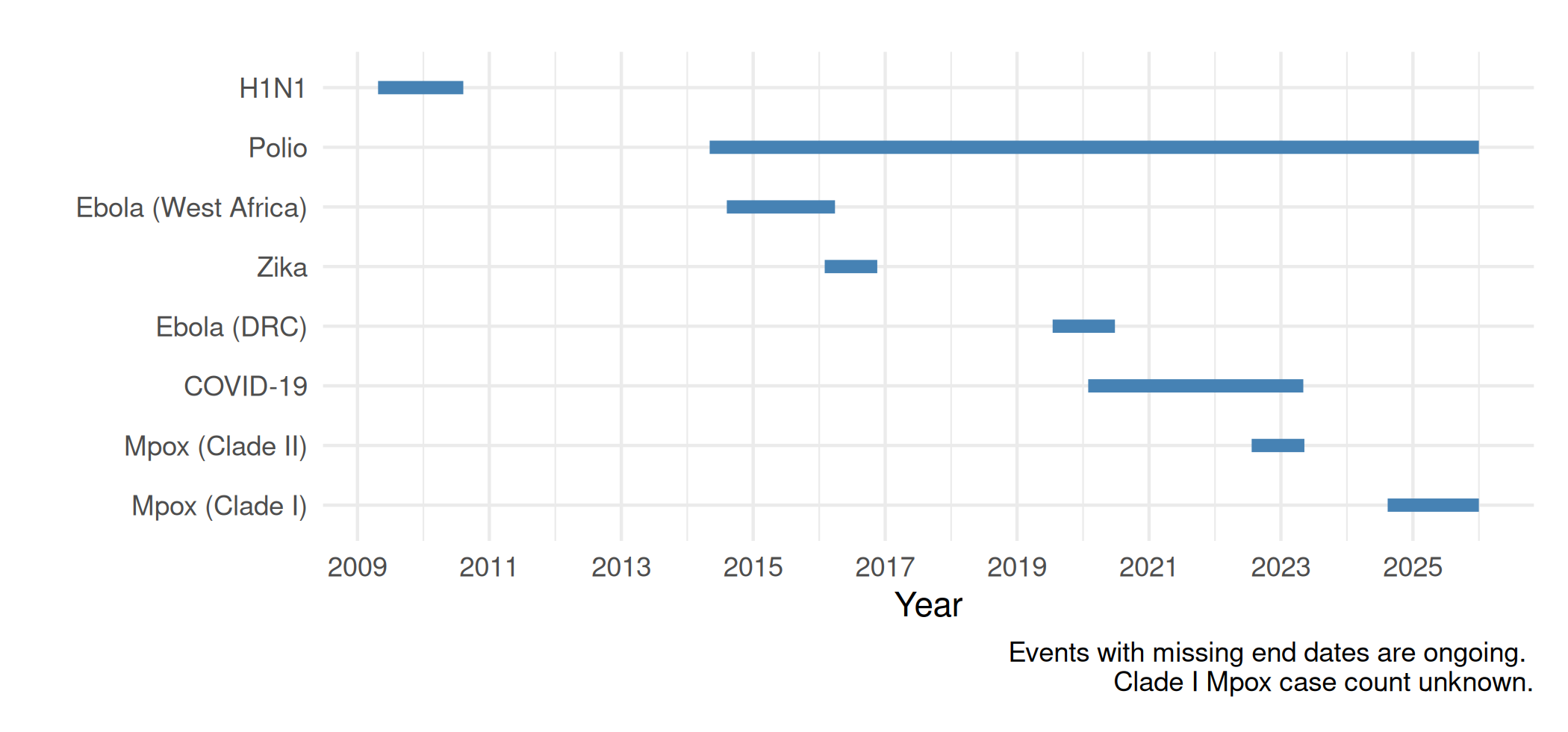
PHEIC declarations to date
Timeline and duration of the eight Public Health Emergencies of International Concern declared through 2025; a ninth — Ebola in the DRC — was declared in 2026.